
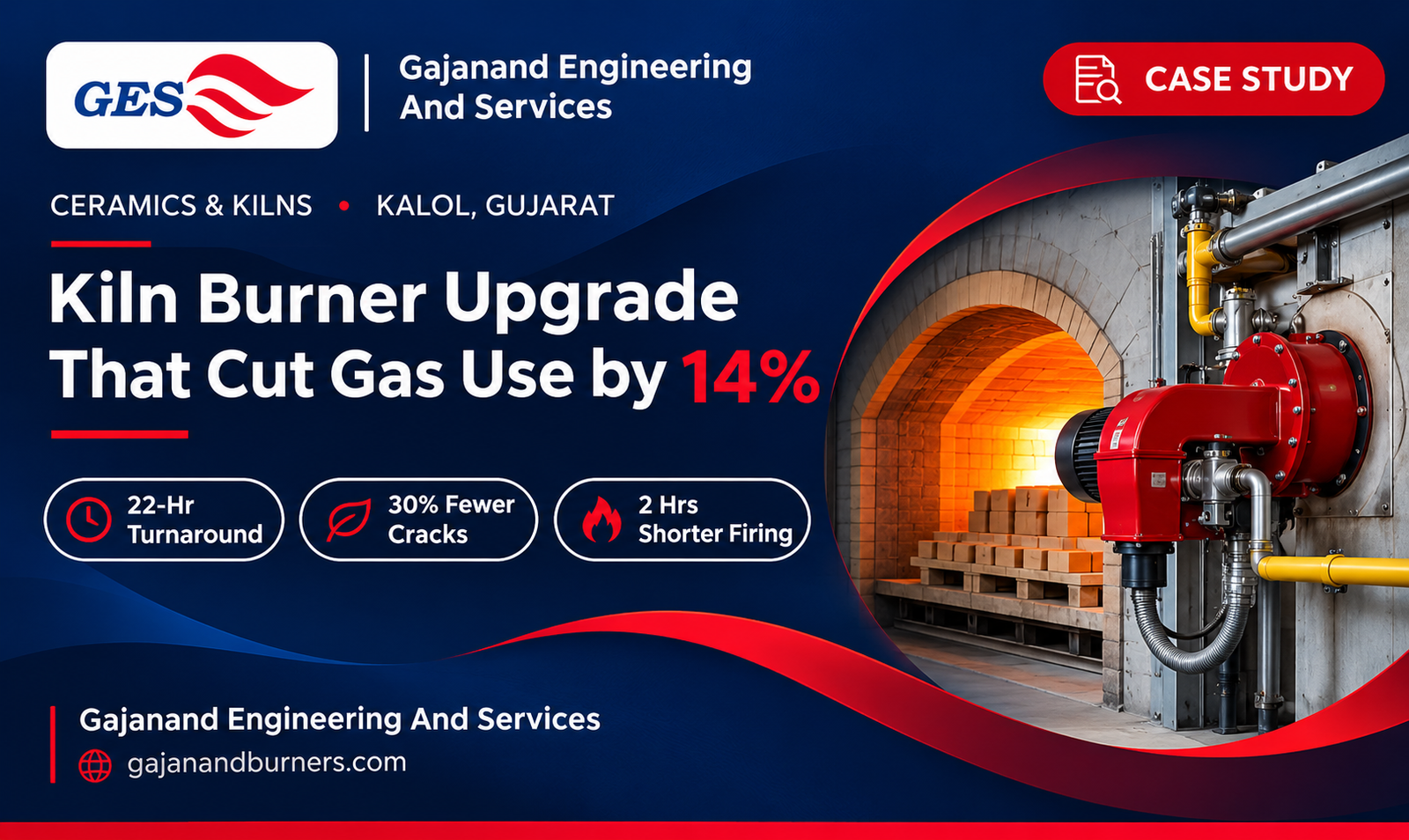
Kiln Burner Upgrade at a Kalol Ceramic Unit: 14% Lower Gas Use and 30% Fewer Cracked Pieces
CERAMIC PRODUCTS & KILN BURNER SYSTEM UPGRADE Burner Automation

Kiln Burner Upgrade at a Kalol Ceramic Unit: 14% Lower Gas Use and 30% Fewer Cracked Pieces

How a Kalol ceramic unit got a steadier firing curve, fewer cracked pieces and 14% lower gas use after we fixed its kiln burner air and gas control.

🏢 Client: Ceramic & Electrical Porcelain Manufacturing Unit • 📍 Location: Kalol Industrial Area, Gujarat • ⏱️ Timeline: 22 Hours, Between Two Firing Cycles • 📅 Nov 2026
⚠️

The Challenge & Technical Bottleneck

The plant fired its ceramic products in a gas-fired shuttle kiln, where the temperature has to rise slowly and follow a set curve. The burners on the kiln were not following this curve properly. The air damper servo motor on two burners was slow and sticky, so the air-gas ratio kept drifting. The gas line filter was also partly choked, which made the gas pressure drop during peak firing. As a result, the kiln heated unevenly, some pieces cracked, and the firing cycle often ran longer than planned. Gas use was higher than the plant's own records suggested it should be.

💡

Our Engineering Solution & Retrofit Execution

We checked the burner firing, the gas pressure and the air damper movement on every burner during a cooling period. Then we replaced the worn servo motors with Siemens SQN servo motors for smooth, repeatable air damper control, and cleaned and refitted the burners with new combustion head and diffuser sets. We installed a new industrial gas filter to keep the gas pressure steady and fitted a fresh Brahma photo cell for reliable flame monitoring. The whole job was done in 22 hours between two firing cycles, after which we tuned the air-gas ratio on flue gas readings across the firing range.

📈

Business Results, Fuel Savings & Safety Compliance

The kiln now follows its firing curve more closely, and the heat is more even across the load. Cracked pieces dropped by around 30%, and each firing cycle finished about two hours earlier. Gas consumption fell by about 14%. The plant also has a regular filter and servo check plan with us, which prevents the same pressure and damper issues from coming back.

Detailed Case Story & Technical Execution

In ceramics, the firing curve decides everything. If the kiln heats too fast or unevenly, pieces crack and the whole load suffers. A Kalol ceramic unit was losing quality because its burners could not hold the air-gas ratio. This is how we, at Gajanand Engineering And Services, fixed it between two firing cycles.

Why the Client Chose Us?

  • Original Siemens, Brahma and gas filter parts available from our Ahmedabad stock
  • Burner-by-burner check of air damper movement and gas pressure
  • Work completed between two firing cycles, so no extra kiln idle time
  • Burner service and repair experience since 2017

Our Approach (Step by Step):

  1. Kiln check: firing pattern, damper movement and gas pressure on each burner.
  2. Diagnosis: sticky servo motors and a choked gas filter found as the cause.
  3. Proposal: a clear parts list and a plan to fit between firings.
  4. Installation: servo motors, head sets, filter and photo cell in 22 hours.
  5. Tuning: air-gas ratio set across the full firing range.
  6. Support: a regular filter and servo check plan.

Client Feedback

“Our firing curve is much steadier now and we see fewer cracked pieces. The team found the choked filter and the slow servo motors, which we had been missing for months.”
— Kiln Supervisor

FAQs:

1. Why does a kiln heat unevenly?

  • Common causes are a drifting air-gas ratio, slow or sticky air dampers, unstable gas pressure or a worn burner head. A burner-by-burner check shows the exact cause.

2. What does a burner servo motor do?

  • A servo motor moves the air damper to match the fuel flow. When it becomes slow or sticky, the air-gas ratio drifts and fuel is wasted.

3. Why is a gas filter important for a kiln burner?

  • A choked filter reduces gas pressure, especially at high firing rates. This leads to weak flames, uneven heating and higher fuel use.

4. Can you work on a kiln between two firing cycles?

  • Yes. We plan the parts and team in advance so the work fits the gap between cycles.

5. Do you supply Siemens servo motors and Brahma photo cells?

  • Yes. We supply original Siemens servo motors, Brahma photo cells and industrial gas filters, with a GST invoice.

Is your kiln heating unevenly, cracking pieces or using too much gas? Call us on +91 97277 74416 or email info@gajanandburner.in for a free site assessment.

SOLVE YOUR PLANT'S BURNER DOWNTIME

Facing a Similar Combustion or Sequence Controller Challenge?

Talk directly with Sukhdevbhai Raval and Gajanand's engineering specialists. We verify part codes, provide schematic wiring diagrams, and dispatch 100% genuine spares across India.

WhatsApp Engineering Lead 💬

📋 Project Snapshot

Client / Plant Ceramic & Electrical Porcelain Manufacturing Unit
Industry / Sector Ceramics & Kiln Firing
Coverage / Location Kalol Industrial Area, Gujarat
Execution Timeline 22 Hours, Between Two Firing Cycles
Key Equipment & Spares Siemens SQN Servo Motor + Burner Combustion Head & Diffuser Set + Industrial Gas Filter + Brahma Photo Cell
MEASURED RESULTS

Key Impact Highlights

14% Gas Consumption Saving
30% Fewer Cracked Pieces
2 Hrs Shorter Firing Cycle
22 Hrs Turnaround Between Firings
📞

Immediate Breakdown Assistance

Need quick burner diagnostics or emergency stock delivery in Ahmedabad, Kadi, Surat, or Ankleshwar?

Call +91 97277 74416